
The ‘Too Late’ Problem: Why Most Medical Ads Miss the Moment
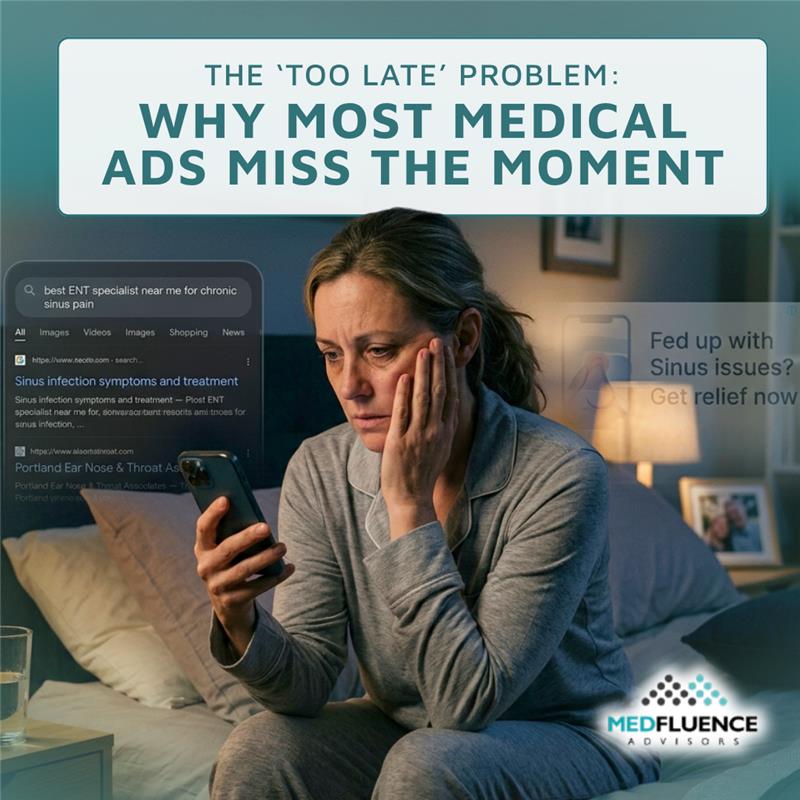
It’s 11:42 p.m. The house is quiet, but the patient isn’t. She’s propped up in bed, one hand pressed against her cheek, the other scrolling through her phone. The pain started as pressure. Now it’s sharp, pulsing. Sinus? Tooth? Something worse?
She searches:
“Why does my face hurt on one side”
“Sinus infection symptoms”
“ENT near me open tomorrow”
Within minutes, she’s made a short list—two clinics, maybe three. She checks reviews. Looks at availability. One site loads faster. Another has clearer next steps. She bookmarks one and eventually falls asleep.
By morning, she’s already decided who to call.
And then—later that afternoon—an ad appears in her feed:
“Struggling with sinus issues? Book your consultation today.”
It’s clean. Well-designed. Probably expensive.
It’s also useless.
Because it arrived too late.
The Decision Window: When Patients Actually Choose
Most healthcare marketing assumes the decision happens at the moment of contact—when a patient calls, fills out a form, or walks into a clinic.
It doesn’t.
The real decision happens earlier. Quietly. Often alone. Long before the phone rings.
Patients move through a series of internal checkpoints, and they do it quickly:
- Symptom recognition: Something feels off—pain, discomfort, fatigue
- Search initiation: They turn to Google, not a provider
- Information filtering: They scan results just enough to narrow options
- Shortlisting: Two or three providers make the cut
- Decision: Often based on clarity, convenience, and perceived trust
By the time a patient reaches out, they’re not exploring—they’re confirming.
This is where most practices miscalculate. They invest heavily in visibility—ads, boosted posts, general awareness campaigns—but fail to show up at the exact moment intent peaks.
That moment is short.
Sometimes minutes. Sometimes hours. Rarely days.
And once it passes, it doesn’t reopen easily.
Behavioral economics explains this through decision momentum. When uncertainty turns into action, the brain seeks closure. It doesn’t want to revisit the process—it wants to move forward, reduce friction, and resolve the problem.
So when your ad appears after that window—after the shortlist is formed—you’re not competing for attention anymore.
You’re interrupting a decision that’s already been made.
The Illusion of Demand: Why Traffic Doesn’t Equal Timing
Many practices look at their metrics and feel reassured:
“We’re getting clicks.”
“Traffic is up.”
“People are seeing our ads.”
On paper, it looks like progress.
But traffic doesn’t tell you when the patient was ready.
A click could mean curiosity. It could mean mild interest. It could mean nothing at all. What it rarely guarantees is intent.
This is where the illusion forms. High traffic creates the appearance of demand—but without timing alignment, that demand never converts.
Because most ads are built for visibility, not readiness.
They target broad categories:
- Age groups
- General locations
- Basic interests
What they miss is context.
A patient casually browsing health content is not the same as a patient searching “urgent care near me open now.” One is passive. The other is decisive.
Yet many campaigns treat them the same.
The result is a mismatch. Ads reach people—but not at the moment they’re most likely to act. And when that happens, performance plateaus. Not because the message is wrong. But because the timing is.
The Psychology of Urgency: Why Timing Beats Creativity
When discomfort peaks, something shifts. The brain stops evaluating and starts acting.
This is where urgency lives—not in headlines or color schemes, but in biology. The brain moves into action mode. Attention narrows. Options shrink. The goal becomes simple: solve the problem as quickly as possible.
This is the action window. And it’s fragile.
If the patient finds a clear path—easy booking, strong reviews, immediate availability—they move forward. Decision made.
If they hit friction—slow website, unclear next steps, delayed response—they hesitate. Sometimes they abandon the search entirely.
What they don’t do is wait for better marketing.
That’s the flaw in most campaigns. They assume creativity will compensate for timing.
It won’t.
A beautifully designed ad shown at the wrong moment loses to a simple, direct message shown at the right one.
Because in healthcare, relevance isn’t just about what you say—it’s about when the patient is ready to hear it.
Consider this:
A patient with mild symptoms might ignore ten ads.
The same patient, in acute discomfort, will act on the first clear solution they see.
Same person. Same message. Different timing. Completely different outcome.
This is why urgency can’t be manufactured. It has to be matched.
You don’t create the moment. You meet it.
The ‘Too Late’ Signals Most Practices Miss
The “too late” problem rarely announces itself directly. It shows up in patterns—subtle at first, then consistent.
You see it in the data, if you know where to look:
- High traffic, low conversions
- Short session durations
- Drop-off after initial interest
- Feedback like “I already booked somewhere else”
These aren’t random issues. They point to one thing: misaligned timing.
The message may be clear. The service may be strong. But if the patient encounters it outside their decision window, it loses impact.
Another overlooked signal is inconsistent performance.
One week feels strong. The next drops off. There’s no clear pattern.
That’s often because the campaign isn’t anchored to patient behavior—it’s running on a fixed schedule, disconnected from when demand actually peaks.
Without timing alignment, marketing becomes reactive. And reactive systems rarely scale.
Where Most Medical Ads Go Wrong
The problem isn’t effort—it’s direction.
Most campaigns fail not because they do too little, but because they focus on the wrong variables.
- Targeting demographics instead of intent
Age, gender, and location matter—but they don’t indicate readiness. - Running static campaigns
No adjustment for time of day, search behavior, or urgency. - Ignoring search-driven behavior
Patients actively seek answers—campaigns must align with that. - Delayed follow-up systems
Even when marketing works, slow responses kill momentum.
Each mistake shares a common thread: marketing is treated as presence, not timing.
But presence without timing is noise.
The Fix: Meeting Patients at the Right Moment
Fixing the “too late” problem doesn’t require more ads. It requires alignment.
Capture high-intent searches:
- “ENT near me”
- “Sinus infection treatment today”
- “Allergy doctor appointment available”
Align messaging with symptoms, not services:
“Constant sinus pressure that won’t go away?”
“Struggling to breathe through your nose at night?”
Reduce friction at every step:
- Fast-loading pages
- Simple booking
- Clear calls-to-action
Implement immediate follow-up:
- Automated confirmations
- SMS responses
- Clear next steps
Use retargeting strategically:
Stay present during the consideration phase—but reinforce action, don’t restart the conversation.
Monitor timing, not just performance:
Understand when conversions happen—not just if they happen.
Practical Application: What to Change This Week
You don’t need a full overhaul. You need alignment.
- Review high-intent keywords
Focus on searches that signal urgency—not just volume. - Check response time
Speed determines whether a lead converts or disappears. - Audit landing pages
Within five seconds, patients should know:
- What you treat
- Who it’s for
- What to do next
- Add symptom-based language
Mirror how patients actually think and search. - Track conversion timing
Identify where delays reduce results.
Fix the timing—and performance follows.
It’s Not the Ad—It’s the Moment
Most medical ads don’t fail because they’re poorly written.
They fail because they arrive too late.
After the search.
After the comparison.
After the decision.
By that point, the ad isn’t persuasive—it’s irrelevant.
This is the gap most practices miss.
They focus on what patients see—without asking when they see it.
But timing isn’t a detail. It’s the difference between attention and indifference.
Because in healthcare, decisions happen in compressed windows—moments of urgency where patients are actively looking for answers.
You can’t recreate that moment later.
You can only meet it when it happens.
That’s the shift:
From visibility → to timing
From constant campaigns → to responsive systems
When that alignment happens, everything changes.
Your ads stop interrupting—and start assisting.
Your follow-ups stop chasing—and start converting.
And your marketing becomes something more than visible.
It becomes relevant.

A Single Word Can Change Patient Action
A patient stares at a colonoscopy prep form, unsure whether to click the button labeled “Submit.” The…
Organic reach is a very powerful tool for businesses’ growth and success, including those in the healthcare industry. A well-crafted and smart social…