
The State of Healthcare Marketing in 2026
Healthcare marketing in 2026 has reached an inflection point.
The rules that once defined the industry have not disappeared. If anything, they have matured. Search still matters. Reputation still matters. Referrals still matter.
But the competitive environment, measurement framework, and patient expectations have fundamentally evolved.
The way practices grow today looks very different than it did even five years ago. Healthcare organizations now operate in a landscape shaped by consolidation, digital transformation, and a patient journey that begins long before a consultation is scheduled.
The Evolution of Healthcare Marketing
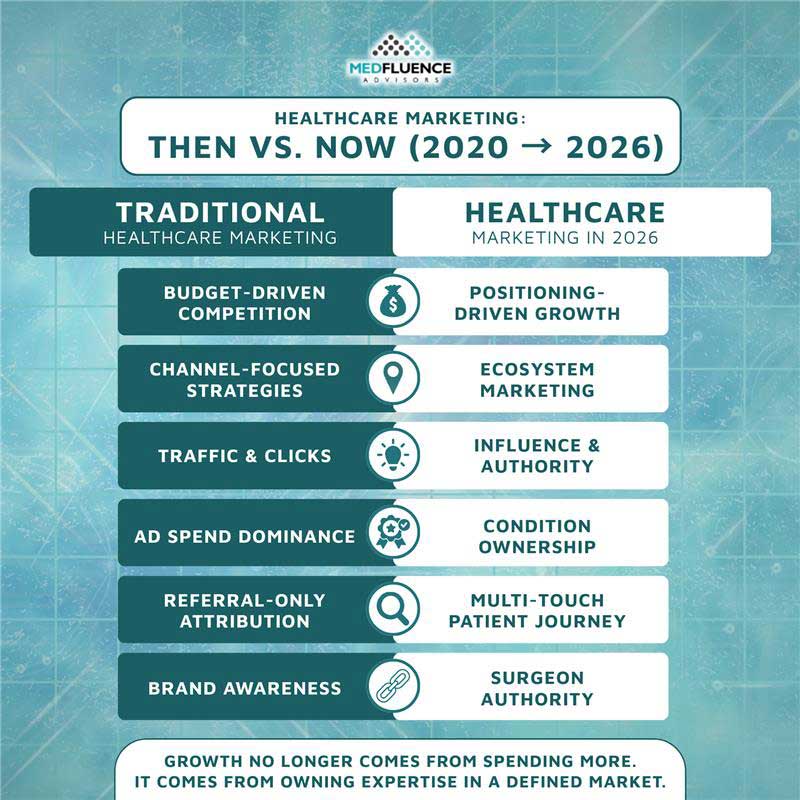
Three structural shifts define this moment.
1. Positioning Has Replaced Budget as the Primary Growth Lever
Healthcare consolidation has reshaped the market. Many physicians now operate within employed or corporate-backed systems, and independent practices often feel pressure to compete with enterprise marketing budgets.
That is the wrong battle.
Large health systems typically market broadly across service lines and geographies. Independent practices, however, have a powerful strategic advantage: they can position themselves narrowly and with precision.
Instead of trying to outspend enterprise competitors, successful practices focus on clarity. They define exactly what they are known for.
- Owning a condition
- Dominating a geographic niche
- Building visible surgeon authority
When a practice becomes synonymous with a specific condition or procedure within a region, it creates leverage that advertising budgets alone cannot replicate.
In 2026, clarity is a competitive advantage. Practices that understand what they want to be known for—and consistently reinforce that positioning—are far more likely to attract the right patients.
2. Influence Matters More Than Clicks
Measurement has also changed.
Marketing attribution is more fragmented than ever. AI-driven search results are reducing traditional organic traffic. Referral patterns increasingly blend digital discovery with physician recommendations and patient research.
For years, many organizations relied heavily on last-click attribution, giving full credit for a conversion to the final interaction before a patient schedules an appointment. But healthcare decisions rarely happen in a single step. Patients often interact with educational content, physician videos, reviews, and referrals long before the final click occurs.
Understanding the full patient journey is now essential for making accurate marketing decisions.
Many marketing dashboards still focus on activity metrics: clicks, impressions, and traffic volume.
But growth is not driven by activity metrics alone.
It is driven by influence.
Practices that are growing consistently tend to measure a different set of signals:
- Engagement depth
- Review velocity
- Share of voice within a specialty
- Conversion quality
- Strategic procedure mix
These metrics reveal something more important than traffic — they reveal market authority.
Healthcare marketing performance must be evaluated at the ecosystem level, not simply at the channel level. A practice’s reputation, content authority, search presence, and patient experience all interact to shape growth.
The Healthcare Influence Ecosystem
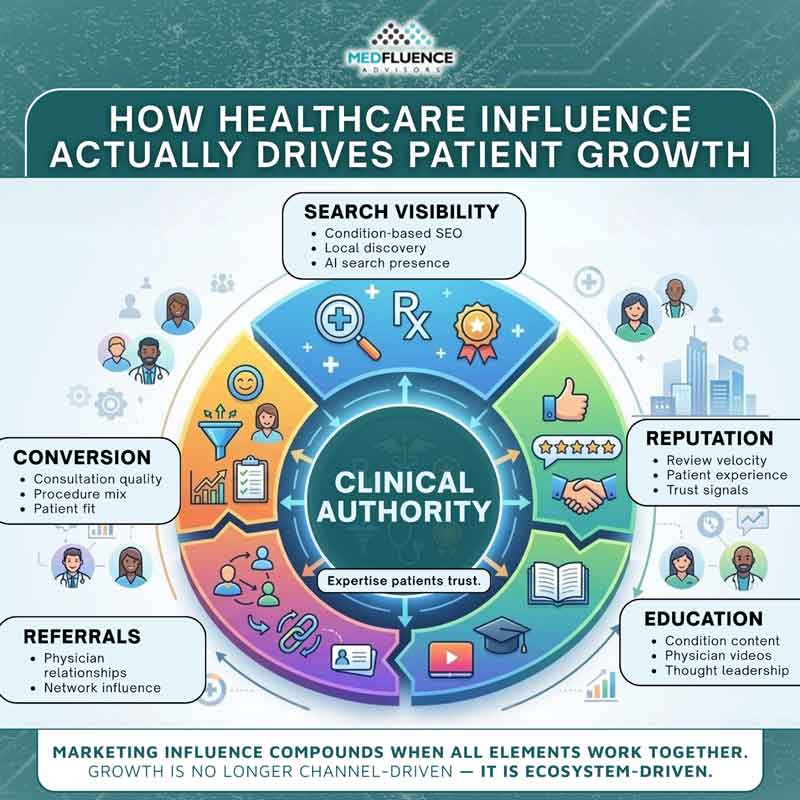
The practices that measure influence will consistently outperform those that measure impressions.
3. Authority Is the Antidote to Convenience
Healthcare has become increasingly transactional.
The rapid expansion of urgent care, telemedicine, and AI-generated health guidance has conditioned patients toward speed and convenience. For many minor issues, patients now expect quick answers and immediate access.
Specialists cannot compete on convenience.
They must compete on expertise.
Authority is built long before a patient schedules a consultation. It develops through condition-specific education, visible physician expertise, and a consistent brand experience across digital and physical touchpoints.
When a patient researches symptoms online, reads educational material, watches a physician video, and sees strong reviews reinforcing credibility, trust begins forming well before the first appointment.
Authority builds trust.
Trust drives case selection.
Case selection drives durable growth.
Practices that focus on building authority are not just attracting more patients — they are attracting the right patients.
The Defining Standard for 2026
The future of healthcare marketing belongs to practices that think in systems.
Search remains a cornerstone of patient acquisition. But sustainable growth requires a full ecosystem that guides patients from awareness to education to action.
This includes:
- Strategic positioning
- Authority-building content
- Reputation and patient experience
- Visibility across digital channels
- Consistent measurement of influence
Healthcare marketing is no longer about generating activity.
It is about engineering predictable influence.
The practices that embrace this shift will not simply adapt to the realities of 2026.
They will lead it.
By: Greg Caesar

A Single Word Can Change Patient Action
A patient stares at a colonoscopy prep form, unsure whether to click the button labeled “Submit.” The…
Organic reach is a very powerful tool for businesses’ growth and success, including those in the healthcare industry. A well-crafted and smart social…