
The Decline of Organic Reach in Healthcare Marketing: Is Paid the Only Way?
Organic reach is a very powerful tool for businesses’ growth and success, including those in the healthcare industry. A well-crafted and smart social media post has the potential to reach a wide range of audiences, including prospective and interested patients, often without direct costs.
As the world becomes increasingly online, the digital landscape in which many businesses and industries operate also has changed drastically. Many businesses and sectors that heavily rely on social media reach are noticing an increasing problem: the decline of organic reach. This raises concerns among many marketers and business owners, as it has made it harder to reach audiences and stand out without resorting to spending.
Let’s explore the reasons behind this and what your practice can do to address it.
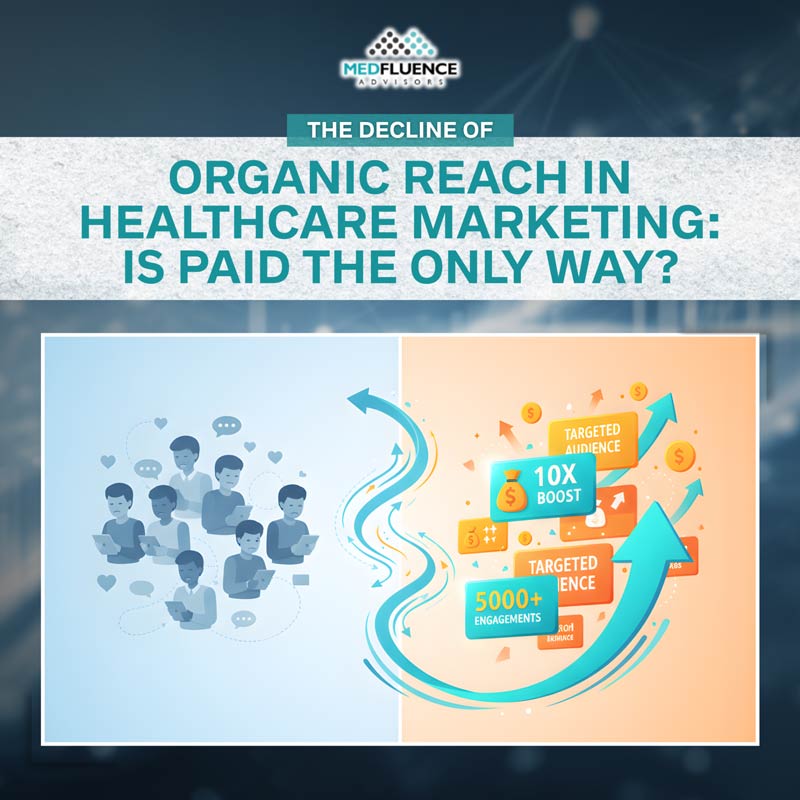
What Is Organic Reach vs. Paid Reach in Healthcare Marketing?
Organic reach refers to the number of people or users who see your page’s free social media content. These users may already be following your page or come across it for the first time. Organic content can help businesses express brand personality and build trust and relationships with their audience.
On the other hand, paid reach refers to the number of people or users who see your page’s paid social media content. When your business pays, social networks (Facebook, TikTok, X (formerly Twitter), etc.) push your content and ads to a larger and targeted audience to increase visibility, clicks, and conversions.
When used together, both organic and paid content can create a powerful tool that drives relationships, trust, results, and growth.
Is Organic Reach Dead?
Saying that organic reach is “dead” is an overstatement. The truth is, organic reach is certainly declining, but not entirely dead.
With organic reach declining and social media algorithms now prioritizing paid content, marketers and business owners must rethink their strategies to reach their target audience and ensure growth.
Why Organic Reach Has Declined
Organic reach is declining everywhere—it’s not just you. Here’s why this happens:
❌Competition overload and content saturation
There is more content created and shared on social media than ever before, increasing the competition to attract your audience’s limited attention and interest. With more competition comes more content online. If your content can’t hold up against other content, then you’re more likely to get lost in the noise.
The oversaturated market continues to make it difficult even for high-quality posts to gain traction and hold interest. This saturation has caused a decline in organic reach, which means harder competition among businesses.
❌Changes in the algorithm
Algorithm changes in social media platforms like Facebook, Instagram, X (formerly Twitter), LinkedIn, and TikTok have become a major reason why organic reach has declined over the past few years. Social media algorithms have become increasingly complex. As social platforms grow, their developers change and adjust their algorithms to prioritize content from family, friends, and paid advertisers over organic posts from businesses like yours.
As more users experience and see more personalized content than ever before, it makes it more difficult for brands and businesses to achieve organic visibility and reach. In addition to that, because social media platform algorithms now prioritize curating and personalizing content, your business page is less likely to be seen by people who are not already following you.
❌The prioritization of paid content
Social media platforms are increasingly prioritizing paid content. Social media algorithms are prioritizing more ads and far less organic content in user feeds.
Social media platforms rely on advertising as a primary revenue source. To encourage businesses to pay for ads and content, they limit organic reach and prioritize paid ads more than ever. This has gradually pushed brands and businesses to invest in paid ads and not just rely on organic reach. This strategy allows social media platforms to monetize their services, after all, and at the end of the day, they, too, are businesses.
This is financially beneficial for social media platforms but might make it harder for other brands and businesses to gain visibility and traction, especially those without a substantial advertising budget.

Strategies to Boost Your Practice’s Organic Reach in 2025
Organic reach might be declining, but it’s not entirely dead. There are a few things you can do and adapt to your practice’s marketing strategy to address the organic reach decline in 2025:
Create high-quality content with real value
Organic content is most likely to rise above the noise and saturation when it offers something of value. Give your audience a reason to follow you and continuously engage with your content. Create content that people want to see–and that is informative, engaging, interesting, and visually appealing content.
Focus on community building and engagement
One effective way to address the increasing decline of organic reach is community building and engagement. Instead of chasing impressions, clicks, and likes, focus on building communities and keeping your audience interested and engaged.
✅Foster two-way conversations.
✅Respond to comments and messages.
✅Create discussion-based posts, such as polls and questions.
✅Host livestreams, webinars, or Q&A sessions to engage with your audience in real-time.
✅Spend about 10 to 15 minutes engaging with your community before publishing content to boost post visibility and engagement.
Utilize social media features and adapt to trends
Social media platforms often develop, launch, and heavily promote new features. Businesses and brands need to be smarter and experiment with and adapt these new features. This can potentially increase organic reach by utilizing what the algorithm prioritizes.
Additionally, trends are consistently popping in and out of social media platforms. Capitalize on these trends to help your practice increase its online visibility organically.
Short-form video becomes an unstoppable force
Short-form video has become a highly favored content format on many social media platforms over static content, and can improve organic visibility and reach.
✅Include relevant and quality content.
✅Hook viewers in the first three seconds.
✅Use fast cuts to maintain interest and attention.
✅Provide quick information and/or health tips that may be widely useful to a wide range of audiences.
✅Add captions to videos for silent viewing.
✅Reuse videos across multiple platforms to maximize reach and engagement.
Leverage user-generated content
User-generated content can also offer a powerful and effective way to increase organic reach. UGC can improve audience interest and engagement and foster trust. Of course, use such content responsibly and with appropriate disclaimers, especially in the healthcare setting.
✅Create and run challenges or contests that will encourage your followers to post about your practice.
✅With appropriate consent and disclaimers, consider reposting and resharing select patient reviews or testimonials on your social media accounts in accordance with FTC guidelines and privacy laws.
✅Encourage your audience to tag your page and use branded hashtags.
Timing and frequency matter
Knowing the best time and frequency to post is crucial for increasing your organic reach. Maximize your organic reach by posting when your audience is online. This way, you achieve early engagement, which can be highly beneficial in social media algorithms. You can determine when most of your audience is online by utilizing social media business tools and analytics. Knowing how often to post will vary significantly based on your industry and the social media platform.
SEO remains a powerful tool
Despite the decline in organic reach, SEO efforts remain a valuable tool. Well-crafted, written, researched, and SEO-optimized content can continue to attract your audience through organic search and reach.
✅Conduct platform-specific keyword research and incorporate these keywords naturally into your social media content, captions, and on-screen text.
✅Use the alt text feature to further integrate relevant keywords and improve reach and discoverability.
✅Make sure that your content serves a purpose and provides value over time.
Are Paid Ads the Only Way to Grow in 2025?
For many brands and businesses that want to expand their visibility and reach, paid ads have become an increasingly important and effective marketing strategy. Here’s how your practice can effectively incorporate and use them in your marketing approach in 2025:
✅Promote high-performing organic posts
If you’re only starting to run paid ads, you can start by promoting already high-performing organic posts with paid ads to extend and maximize their reach.
✅Use paid ads to attract
Boost your posts with paid ads to attract new followers. Constantly give them a reason to continue following your business and engage with your posts by ensuring quality, informative, and consistent content.
✅Audit current ad performance and focus on ROI calculations
Audit current ad performance and determine which ads perform well. Use ROI metrics to guide responsible marketing budget allocation. If some ads aren’t performing well and aren’t giving you your expected numbers, shift your focus to other ad posts or social media platforms where your numbers are better.
Leverage analytics tools and measure and track ad performance as well as what drives leads in real time. This will allow you to determine what works and what doesn’t, and adjust your strategies to maximize reach.
✅Start small and experiment
It wouldn’t hurt to start paid ads small. Experiment with creatives, what kind of content performs best to boost and determine what works and what doesn’t.
✅Ensure compliance
In creating a healthcare marketing strategy, it is of utmost importance to ensure that all advertising and marketing strategies remain compliant with healthcare privacy and advertising regulations.
Aiming for a Balanced Approach: Combining Paid Ads and Organic Marketing Efforts
In 2025, when brands and businesses compete for people’s limited attention, it’s more crucial than ever to aim for a hybrid marketing approach: combining organic and paid reach and marketing efforts.
While organic content and marketing foster authenticity, trust, and loyalty, it is paid advertising that allows brands and businesses to reach broader audiences and achieve immediate results. Paid ads can also amplify organic content, ensuring that it reaches more people who can potentially be part of the community you are building.
Paid advertising can help support organic brand and business growth by widening their profile’s reach and giving them a bigger opportunity to foster trust and create a community.
✔️Ensure that both organic and paid content align in tone, style, and message to create a seamless experience.
✔️Use paid ads to attract new followers and leverage organic content to nurture this interest and build meaningful relationships with your new audience.
✔️Promote high-performing organic posts with paid ads to further maximize reach and ROI.
✔️Run paid ads while maintaining a consistent organic posting schedule to keep your audience interested and engaged.
Navigating the Future of Organic and Paid Healthcare Marketing
The decline of organic reach has posed challenges for many brands and businesses, especially those that rely on unpaid and organic content alone. One might think that paid ads are the only way to foster growth from here on out, but this couldn’t be further from the truth. While organic reach has significantly declined, there are still areas of growth opportunities, with a strategic approach in mind.
Making adjustments to organic content marketing, including increased community engagement, leveraging user-generated content, and utilizing social media features and trends, can boost organic reach.
Additionally, taking a hybrid approach by combining both organic and paid marketing efforts can strike the perfect balance to reach a broader audience with paid ads and, at the same time, foster authenticity, trust, and loyalty with organic content.
A Single Word Can Change Patient Action
A patient stares at a colonoscopy prep form, unsure whether to click the button labeled “Submit.” The…
It’s 11:42 p.m. The house is quiet, but the patient isn’t. She’s propped up in bed, one hand pressed against her cheek, the other scrolling…