
8 Proven Marketing Strategies for Surgeons and Specialty Practices
 Navigating the Competitive Landscape: Marketing Strategies for Surgical Specialties
The global healthcare market for surgical specialties, such as ear, nose, and throat (ENT), orthopedics, and plastic surgery, is experiencing significant growth. The ENT treatment market alone was valued at $16.15 billion in 2021 and is projected to exceed $27.5 billion by 2030, growing at a CAGR of 6.3%. Similarly, the orthopedic and plastic surgery markets continue to expand due to aging populations, advancements in minimally invasive procedures, and rising patient demand for both functional and aesthetic treatments.
As the demand for specialized surgical care increases, so does competition. Today’s patients are more informed, discerning, and selective, expecting not only exceptional medical care but also a seamless and patient-centric experience from the first touchpoint. This shift in patient behavior requires surgical practices to implement strategic marketing approaches that differentiate their services, establish trust, and drive patient engagement.
For surgical practices to thrive in a competitive landscape, they must go beyond traditional marketing efforts. A data-driven, patient-focused strategy is essential to attract new patients, retain existing ones, and build a strong brand presence in an increasingly digital and consumer-driven healthcare environment.
The Importance of Effective Surgeon Marketing and Surgical Practice Marketing
Surgeon marketing and surgical practice marketing involve the strategic promotion of surgeons, specialty clinics, and healthcare organizations to attract new patients, build trust, and establish expertise within a competitive healthcare landscape. Effective marketing goes beyond patient acquisition—it helps strengthen a surgeon’s reputation, increase visibility, and support long-term practice growth.
A key component of marketing for surgeons is providing valuable, relevant information that empowers patients to make informed healthcare decisions. By educating and engaging patients, practices can encourage proactive participation in their care while fostering trust and loyalty.
Trust is the foundation of every successful specialty practice. A strong marketing strategy helps demonstrate expertise, showcase patient success stories, and highlight a commitment to quality care. Combined with a strong professional reputation, these efforts can significantly influence patient decisions and contribute to sustainable practice growth.
The New Age of Healthcare Marketing Is Online and Digital

While traditional word-of-mouth referrals were the norm in the past, the healthcare landscape is rapidly evolving. Today’s modern patients are increasingly online and digital. Whether the healthcare industry accepts it or not, this is the new age of healthcare marketing.
Today’s patients are smarter and many of them rely on online research to make important healthcare decisions. They spend a lot of their time researching their symptoms and conditions, using new-found healthcare information to research and read about their treatment options, medical facilities, and potential healthcare providers. They also pay great attention to what other patients have to say about specific clinics and physicians.
Because of this modern evolution, digital marketing and a practice’s online reputation are now a top priority for most healthcare practitioners and marketers. With the right digital marketing strategy in place, your practice gets in front of the right audience and potentially acquires new patients, increasing your patient base.
What Makes Marketing for Specialty Practices Different?
Marketing for specialty practices differs from marketing for primary care because patients often spend more time researching symptoms, procedures, treatment options, and providers before scheduling an appointment. Whether they are considering sinus surgery, cataract treatment, spine care, or cosmetic procedures, patients typically seek reassurance, education, and evidence of expertise before making a decision.
Specialty practices also rely on a combination of direct patient acquisition and physician referrals. This means marketing strategies must support both patient-facing visibility and professional credibility. Successful specialty practice marketing focuses on building trust, demonstrating expertise, and creating a seamless patient experience across every touchpoint.
Effective Marketing Strategies for Your Surgical Practice
Consider these effective marketing strategies to help your surgical specialty practice stand out in a highly competitive healthcare landscape:
1. Build a professional website
As we said above, today’s modern patients use online research to look for healthcare providers and facilities. In this sense, a practice’s website is often the first point of contact between your practice and potential patients. Make sure your website has a user-friendly and pleasing design. It should have fast loading times and must have a mobile-friendly interface.
Your practice’s business website must be clear and informative and must encourage visitors to take action, so adding a scheduling button is highly encouraged. Feature informative healthcare content and showcase several patient testimonials.
All these elements should create a good first impression that can encourage visitors to choose your practice for their healthcare needs.
Additionally, it is important to optimize your website. This includes improving load times, ensuring a mobile-friendly design, and employing SEO keywords to rank high in search engine rankings.
2. Focus on local SEO optimization
While SEO optimization best practices remain crucial to effective healthcare marketing, local SEO is how you make sure that patients in your local community find your practice.
In optimizing your website, make sure you incorporate local keywords like “San Francisco balloon sinuplasty” in your website’s copy and meta tags. You can also use such localized keywords in any content you publish within your website.
Establishing backlinks from other organizations in your local community can further increase your credibility and authority in the local scene.
- Don’t neglect your Google Business Profile
Additionally, you can leverage your practice’s Google Business Profile for local SEO optimization purposes. Make sure that you provide all relevant information including the name, complete address, and phone number of the business. Include the updated business hours of your facility and add compelling images that showcase your business and ENT surgical services you provide.
3. Prioritize targeted advertising
Targeted advertising is a powerful and effective marketing tool that gets your business in front of the right people. Targeted advertising allows you to target specific demographics who might need your surgical services.
This type of advertising will allow healthcare marketers to segment their target audience based on age, location, gender, and even income level. Top advertising platforms like Google and Facebook Ads (and other social media ads) allow marketing professionals to set precise targeting parameters.
Create high-quality ad copies and landing pages to increase the conversion rate of ads you publish. Use images and videos to grab your audience’s attention.
PPC (pay-per-click) ads are also highly effective. Through PPC ads, you bid for specific keywords to place your practice’s website at the top of search results. This way, potential leads who are actively searching for treatments and procedures can find your practice.
4. Build expertise and authority with content marketing
Building credibility and authority is how those in the healthcare industry build trust. As we’ve said before, trust is a crucial part of success in healthcare. Effective content marketing can help build your practice’s credibility, expertise, and authority in the healthcare field. The more your target audience trusts you, the more likely they are to choose your practice for their healthcare needs.
- Video marketing is increasingly effective
Marketing via video content brings overwhelming positive results for many businesses in many sectors – and the healthcare industry should also tap into this potential. Healthcare practitioners and marketers can leverage high-quality video content to educate, engage, and build trust with their audience, encouraging them to choose your practice for their care needs.
Facebook, TikTok, Instagram, YouTube – the choices to promote your practice with video content are endless. Choose topics that apply to your practice – in this case, surgical specialties and treatments. Answering a set of frequently asked questions can both engage your audience and highlight your expertise in the field. - Leverage medical illustrations, animations, and visuals
Utilize medical illustrations, animations, and visuals to simplify complex conditions, procedures, and treatments. Clear, engaging visuals enhance patient understanding, reducing reliance on medical jargon. This not only empowers patients to make informed healthcare decisions but also reinforces your commitment to their clarity and well-being. - Incorporate eLearning and virtual reality simulations
Virtual reality (VR) simulations and eLearning are new and innovative ways to educate your patients in an interactive and easy to understand way. You can use these methods to demonstrate ENT procedures engagingly and interactively, providing a unique experience for patients and potential patients.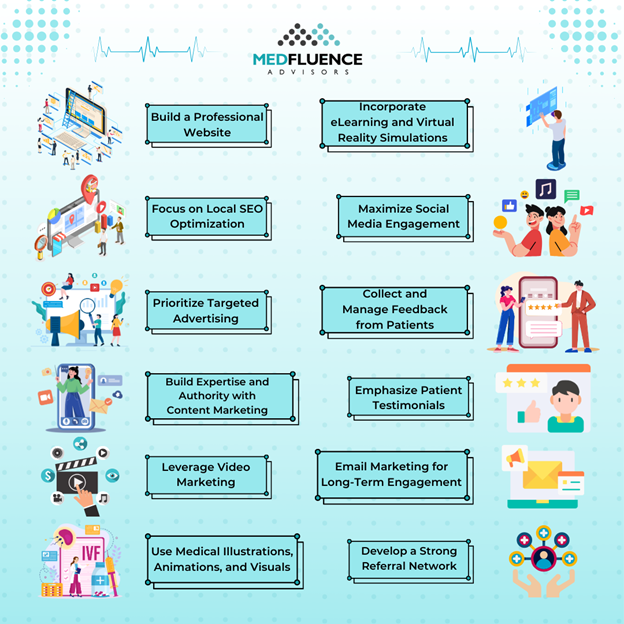
5. Social media continues to dominate
Social media continues to dominate the marketing industry, and social media platforms still are powerful tools to connect with your target audience and build relationships with them. You can take your reach to new heights by leveraging social media platforms like Facebook, X (formerly Twitter), Instagram, TikTok, and LinkedIn, to name a few.
Use your practice’s social media platforms to publish informative, engaging, and high-quality content. You can also use social media to build connections with your patients, not just market to them. Respond to comments and messages and make your audience feel heard and seen.
6. Collect and manage feedback from patients
Today’s patients are more informed than ever, approaching their healthcare decisions with careful scrutiny. Patients value authenticity and social proof when researching and choosing a healthcare provider.
Learn to collect and manage feedback from past patients. Highlight positive patient testimonials in your practice’s website and social media platforms. Ask patients to leave reviews on your website or on any of your social media platforms and make sure to highlight the positive reviews. You can give incentives to encourage them to leave reviews
It’s important not to ignore negative reviews. Embrace them as valuable feedback that highlights areas for improvement. Respond promptly, acknowledge the concerns, and offer solutions to address the issues. This shows your audience that you genuinely care about enhancing their experience.
- Emphasize patient testimonials
Potential patients value what others have to say about their experiences with your facility and the quality of your services. They want to know that they can trust you as their healthcare provider, and emphasizing patient testimonials is one effective way to go about it.
7. Email marketing connects you with patients
Email marketing is an effective way to connect with patients and create long-term relationships with your audience. Send regular newsletters, targeted campaigns, and promotional messages to keep them engaged and interested in your practice. Building strong relationships with your patients will encourage loyalty, which is key to a successful and long-term business.
8. Develop a strong referral network with your peers
Of course, networking with other healthcare professionals and building good working relationships with them is a crucial component of effective healthcare marketing. This will open opportunities for referrals and will regularly bring in new patients to your door. It also lets you stay current on the latest news about healthcare technologies and the latest medical knowledge.
Get yourself out there by participating in medical conferences, live or via webinars. This can build strong bonds between you and your peers.
Patient Acquisition for Specialty Practices
Patient acquisition is one of the primary goals of healthcare marketing. For specialty practices, attracting new patients requires a combination of digital visibility, educational content, and reputation management.
Effective patient acquisition strategies include:
- Search engine optimization (SEO)
- Local SEO and Google Business Profile optimization
- Pay-per-click (PPC) advertising
- Content marketing and patient education
- Online reviews and reputation management
- Conversion-focused website design
Today’s patients often begin their healthcare journey online. By ensuring your practice appears when patients search for symptoms, procedures, and treatment options, you can connect with individuals actively seeking care and guide them toward scheduling an appointment.
Referral Growth for Specialty Practices
While digital marketing is essential, referrals continue to play a significant role in specialty practice growth. Many surgical practices receive patients from primary care physicians, urgent care providers, and other specialists who recognize the need for advanced evaluation or treatment.
Building a strong referral network requires:
- Consistent communication with referring providers
- Educational outreach programs
- Community engagement
- Professional networking
- Prompt reporting and follow-up after patient visits
Practices that cultivate strong professional relationships often benefit from a steady stream of qualified referrals while strengthening their reputation within the healthcare community.
How ENT, Ophthalmology, and Spine Practices Grow Differently
Although many marketing principles apply across healthcare, different specialties often require different growth strategies.
ENT Practices
ENT practices commonly attract patients through symptom-focused searches related to sinus infections, allergies, hearing loss, sleep apnea, and nasal obstruction. Local SEO, educational content, and procedure-specific marketing often play a significant role in patient acquisition.
Ophthalmology Practices
Ophthalmology practices frequently focus on cataract surgery, LASIK, dry eye treatment, and vision correction procedures. Patients often spend considerable time researching treatment options, making educational content and patient testimonials particularly valuable.
Spine Practices
Spine practices often serve patients experiencing chronic pain, mobility issues, or neurological symptoms. These patients may research extensively before selecting a provider, making reputation management, physician referrals, and detailed educational resources especially important.
Understanding how patients search for care within each specialty allows practices to tailor their marketing strategies more effectively and improve long-term growth.
An Ethical Approach Is at the Heart of Healthcare Marketing
While these marketing strategies are essential for driving your business toward success, it’s crucial to remember that ethical practices must always be at the core of healthcare marketing.
When launching any marketing campaign or creating materials, strict adherence to healthcare regulations is non-negotiable. Protecting patient confidentiality, especially when using photos or videos, should always be a top priority. All materials must be truthful—misleading claims or exaggerations can harm your credibility.
Violating healthcare regulations not only damages public trust but can also result in fines, seriously impacting your practice’s reputation and financial stability.
Frequently Asked Questions About Surgeon Marketing
What is surgeon marketing?
Surgeon marketing refers to the strategies used to promote surgeons and surgical practices, attract new patients, build trust, and increase visibility within a competitive healthcare market.
How do surgeons attract new patients?
Many surgeons attract new patients through a combination of SEO, local search optimization, content marketing, paid advertising, online reviews, and physician referrals.
What marketing strategies work best for surgical practices?
The most effective marketing strategies typically include a professional website, local SEO, patient education content, reputation management, targeted advertising, and referral development.
How can specialty practices increase referrals?
Specialty practices can increase referrals by building strong relationships with primary care physicians, maintaining consistent communication with referring providers, and participating in community and professional outreach initiatives.
What makes marketing for surgeons different from primary care marketing?
Surgeons and specialty practices often treat conditions that require more research and consideration from patients. As a result, marketing efforts typically focus more heavily on education, trust-building, reputation management, and referral development.
Conclusion: Your Surgical Practice Must Embrace Effective Digital Marketing for Business Success
Marketing is a powerful tool in establishing public trust and credibility. At Medfluence Advisors, we specialize in helping healthcare professionals navigate the complex road of healthcare marketing. We partner with many healthcare facilities and help them thrive in the competitive market of the industry.

A Single Word Can Change Patient Action
A patient stares at a colonoscopy prep form, unsure whether to click the button labeled “Submit.” The…

Organic reach is a very powerful tool for businesses’ growth and success, including those in the healthcare industry. A well-crafted and smart social…